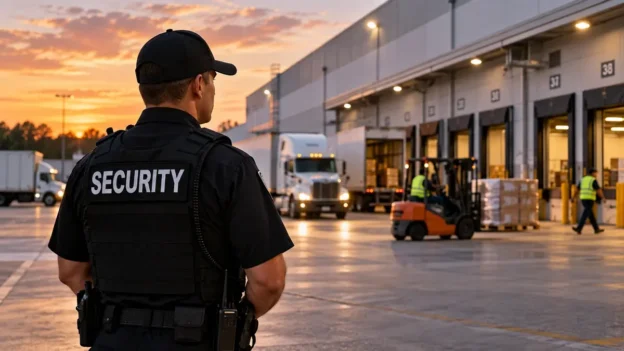
Distribution centers are built to keep things moving. Employees arrive for their shifts, trucks enter and exit, shipments are loaded and unloaded, and inventory moves through the facility throughout the day and night.
All that activity creates security challenges. With so many people, vehicles, and shipments coming and going, even a small lapse in procedures can expose a facility to theft, unauthorized access, or operational disruptions.
Protecting a distribution center requires more than a security officer stationed at the entrance. It takes trained personnel, clearly defined procedures, and active supervision tailored to the demands of logistics operations.
Here are five common distribution center security challenges—and how to address them without slowing down business.
1. Controlling Employee, Vendor, and Visitor Access
Distribution centers may have hundreds of people entering and leaving during a typical day. Along with permanent employees, facilities must accommodate temporary workers, contractors, vendors, and visitors, often across multiple entrances and shifts.
Keeping track of everyone can be difficult, particularly during shift changes or peak operating periods. Tailgating, shared credentials, and inconsistent enforcement of access policies can allow unauthorized individuals into restricted areas.
How to address it: Establish site-specific access control procedures that clearly define who can enter the facility, which areas they can access, and how their authorization is verified.
Security officers should be trained to recognize unauthorized access attempts, enforce identification requirements, and manage visitor check-in procedures consistently. Just as importantly, these processes should be designed to keep authorized personnel moving efficiently.
2. Verifying Drivers, Vehicles, and Documentation
Every truck entering or leaving a distribution center represents another potential security vulnerability.
Busy shipping schedules can make it difficult to verify driver identities, confirm vehicle information, and ensure that the proper documentation accompanies each shipment. Unauthorized pickups, fraudulent credentials, and paperwork discrepancies can lead to cargo losses and costly delays.
How to address it: Implement standardized verification procedures for drivers, vehicles, and shipping documentation, including bills of lading.
Trained security officers can confirm driver identification, check vehicle credentials against expected arrivals, and identify discrepancies before a shipment leaves the property.
Consistency is especially important during high-volume periods, when pressure to keep trucks moving can lead to shortcuts. A well-designed verification process helps protect shipments while minimizing unnecessary delays for legitimate drivers.
3. Securing Docks, Yards, and Shipping Areas
Distribution center security doesn’t end at the building’s doors. Loading docks, trailer yards, parking areas, and shipping zones all present potential vulnerabilities.
Large properties may have dozens of dock doors, parked trailers, and multiple vehicle access points. Maintaining visibility across these areas can be challenging, especially overnight and on weekends when fewer employees are present.
Unattended trailers, unsecured dock doors, and inconsistent inspection procedures can create opportunities for theft or unauthorized activity.
How to address it: Combine controlled access with regular patrols, vehicle inspections, and consistent lock and seal management.
Depending on the property’s layout, foot, bicycle, and vehicle patrols can help security personnel monitor areas that aren’t continuously visible from a fixed post.
Patrol routes and inspection procedures should reflect the facility’s operating schedule, physical layout, and areas of greatest risk. Documented inspections also provide management with greater visibility into potential problems before they escalate.
4. Protecting Cargo and High-Value Products
Cargo theft isn’t limited to trucks on the road. Inventory can be vulnerable throughout the distribution process, from receiving and storage to staging and outbound shipping.
High-value merchandise presents an especially attractive target. However, even lower-value products can generate significant losses when theft occurs repeatedly or goes undetected.
Both internal and external threats must be considered. Inadequate access controls, poorly documented inventory movements, and gaps in the chain of custody can make it difficult to identify when or where losses occur.
How to address it: Establish additional safeguards for sensitive inventory and high-value products.
These may include restricting access to designated storage areas, monitoring cargo movement, verifying shipment documentation, and maintaining clear records of who handles inventory at critical points.
Regular loss-prevention audits can also help identify vulnerabilities in receiving, storage, and shipping procedures. Addressing those gaps proactively is far less disruptive than investigating losses after they occur.
5. Maintaining Guard Performance and Accountability
Even the best security procedures are only effective when they’re followed.
A distribution center may have security officers assigned to every shift, but staffing alone doesn’t guarantee consistent performance. Officers must understand their responsibilities, follow established post orders, conduct required inspections, and respond appropriately to incidents.
Without active supervision, standards can slip. Procedures may be enforced differently between shifts, inspections may be missed, and recurring issues may go unresolved.
How to address it: Look beyond the number of officers assigned to a facility and evaluate how the security provider manages their performance.
Site-specific training, clearly documented post orders, unannounced field inspections, and dedicated management oversight all contribute to more consistent service.
Distribution center leaders should also be able to answer several important questions: Who supervises the officers? How frequently are inspections conducted? How are performance issues documented? And how quickly does management respond when a concern arises?
A security provider should be accountable not only for staffing posts but also for ensuring that officers perform their duties consistently.
Why Distribution Centers Choose StarPoint Protective Services
Distribution and logistics facilities have security requirements that differ from those of a typical office building or retail location. Protecting these operations requires an understanding of truck traffic, shipping documentation, access control, cargo movement, and the importance of maintaining operational efficiency.
StarPoint Protective Services specializes in security for the distribution, transportation, and logistics industries, providing trained officers backed by active field supervision and management support.
Rather than simply assigning officers to a location, StarPoint emphasizes consistent performance and accountability through:
- 24/7 unannounced field supervision inspections to help maintain security standards across shifts
- Company-owned supervisory vehicles that support field oversight
- Dedicated field managers assigned to specific sites for ongoing supervision and support
- A New Jersey State-certified SORA instructor on staff to support officer training
- Site-specific training and operating procedures tailored to each facility’s security requirements
- Direct management oversight to address client concerns and reinforce accountability
This approach helps distribution center operators maintain consistent security procedures while keeping employees, drivers, vehicles, and shipments moving.
Security That Protects Operations Without Slowing Them Down
Effective distribution center security must accomplish two goals: protect people and property while supporting the efficient movement of goods.
That means controlling access without creating unnecessary bottlenecks, verifying shipments without delaying legitimate drivers, and maintaining consistent security coverage across every shift.
It also means choosing a security provider that understands logistics operations and takes responsibility for the quality of its service.
Are you receiving the right level of security service at the right price?
Schedule a confidential, no-obligation 15-minute security review with StarPoint Protective Services to discuss your current staffing, supervision, service levels, and security priorities.